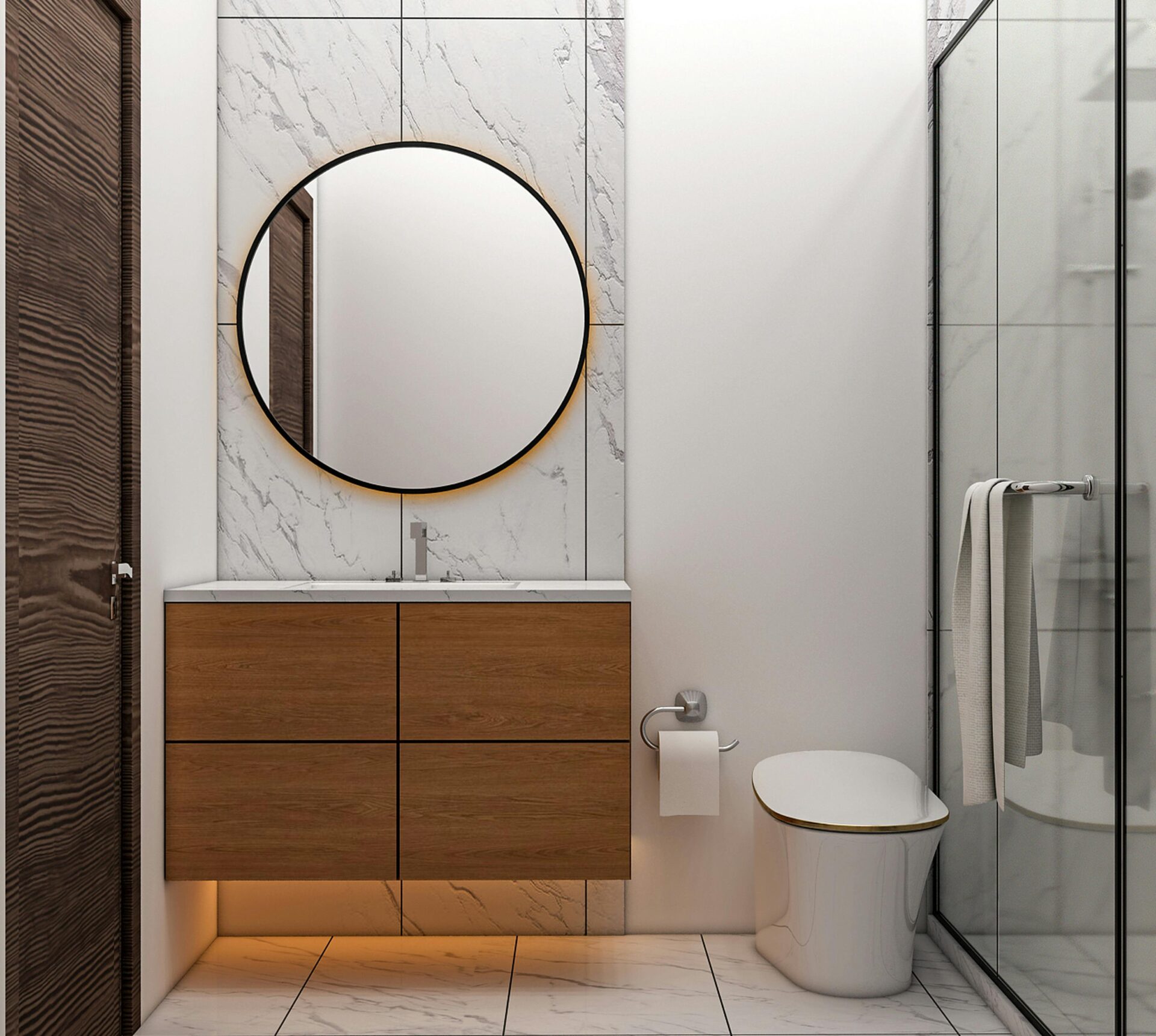
A small bathroom is often a big problem; owners will confirm. This is because, at a minimum, it has to fit a toilet, a sink, and a shower. Obviously, it also needs enough storage to keep the space functional, as well as room to actually move around without constantly bumping into things (some bumping may be unavoidable though). In other words, everything has to coexist in a small room that usually can’t grow without serious money or serious structural changes.
The good news is, square footage isn’t the only thing that determines how well a bathroom works. A set of targeted, relatively inexpensive upgrades, all of which we’ll cover down below, can make a micro bath work harder and feel more open.
A Quick Planning Reality Check Before You Touch Anything
Many space-saving upgrades won’t actually do much on their own. Since the goal is more space and better functionality, they really should be paired with other space-saving upgrades. So, for example, a wall-mounted vanity can help a little, but it works better when you also move storage into the wall. Likewise, large-format tile often makes the space feel larger but only when it’s paired with minimalist fixtures and minimal framing.
In other words, every small bathroom aiming to be more functional should be treated as a system that consists of different parts, where each part is connected to the others. This means that each decision you make should support the said system as a whole, not just one or two parts. A corner sink won’t do much if the bathtub takes half of the space.
If you want a broader framework for evaluating small bathroom renovation ideas, Jaeger Lumber’s breakdown offers a solid way to think through layout, fixture selection, and visual continuity without chasing trends or overbuilding.
With that in mind, here are the upgrades that make small bathrooms function better and often look a little roomier.
Pocket Doors (or Wall-Sliding Doors)
A swinging door eats up 9–10 square feet (sometimes up to 12). In a small bath, that’s a lot of space. So, pocket doors: they return that precious space immediately. The alternative is surface-mounted slidersl both work.
Installation: Pocket doors work best when installed during a renovation since the wall cavity needs modification. Surface sliders install faster and avoid opening the wall, though sound privacy drops slightly. Pick your battles!
Budget : Surface-mounted sliders are budget-friendly. Pocket doors cost more due to framing work, but the space payoff is significant.
Corner Sinks
Corner sinks can solve clearance issues near doors or showers as well as free up wall length for storage. If you don’t mind the look (because some people do), they can be a real space-saver.
Installation: Plumbing angles require planning, but no expensive parts. A wall-mounted faucet is best.
Budget: Fixtures cost roughly the same as standard sinks. Labor increases slightly due to nonstandard placement.
In-Wall Cisterns (Wall-Hung Toilets)
This is one of the highest-impact upgrades for micro baths, saving up to 10 inches. The tank disappears into the wall, the bowl floats, and the floor opens up. An easy win!
Installation: Requires a deeper wall cavity (typically 2×6 framing). Best done during a renovation rather than as a retrofit.
Budget: Higher upfront cost, but long-term maintenance is reasonable. Many commercial-grade systems last decades.
Wall-Mounted Vanities
Lifting a vanity off the floor is a good way to make the space feel a little larger. You gain visible floor area that is also easier to clean, as well as a lighter visual footprint.
Installation: You need solid blocking in the wall to support the load. Plumbing typically shifts upward, which adds a bit of labor but stays manageable in most remodels.
Budget: Floating vanities are more expensive than floor-standing ones, and there are installation costs to include, too.
Recessed Niches
Every shampoo bottle that sits on the tub edge steals usable space. Recessed niches move storage into the wall thickness you already have.
Install notes: Best installed during tiling. Waterproofing is a must.
Budget: Low material cost, moderate labor. The value-to-cost ratio stays high.
Mirrored Cabinets Instead of Flat Mirrors
With these, you get storage and reflection in one move. And unlike open shelving, cabinets hide clutter (which matters more in small rooms).
Installation: Recessed versions require wall depth. Surface-mounted models still improve storage without opening the wall.
Budget: Affordable across most price tiers. Electrical integration for lighting bumps the cost slightly.
Large-Format Tiles
This may sound counterintuitive but it works: fewer grout lines make walls and floors read larger.
Installation: Substrate prep must be flat. Larger tiles magnify imperfections.
Budget: Tile cost varies widely, but labor can increase due to handling and layout precision.
Layered Lighting
One overhead light can flatten everything. Layered lighting, on the other hand (so ambient, task, and accent) adds depth without adding square footage.
Installation: Plan wiring early. LED strips behind mirrors or under vanities deliver high impact with low energy use.
Budget: LED components are affordable. Electrical labor is the main variable.
Towel Warmers That Double as Racks
They dry towels faster, reduce humidity, and replace bulky towel bars. In small baths, every multifunctional element counts.
Installation: Electric models install easily. Hydronic versions tie into plumbing and cost more.
Budget: Entry-level electric units stay reasonable and pay off in comfort.
About Author