You are familiar with the sensation of living in a smaller space. You adore your apartment, but occasionally you run into an invisible wall when attempting to host some friends or just relax on the couch. That sudden feeling of being confined, claustrophobic, and convinced that you need a larger space. Isn’t it frustrating? A tiny living room can easily become disorganized, unwelcoming, and limit your capacity to entertain or fully unwind.
Professional interior designers are aware of the game changing fact that space is frequently an illusion. The way your brain interprets the room’s boundaries is more important than the tape measure. You don’t need a windfall or a major renovation. All you have to do is use what you already have more strategically and intelligently. You can drastically alter how you view and utilize your living area by utilizing the deft use of light, reflection, and multipurpose features.
The Magic of Reflection: Mastering Mirrors
Let this be the one piece of advice you take away from the entire article: Purchase a large mirror. Despite being the oldest and most effective trick for enlarging a room, it is frequently used improperly. Use the mirror as an architectural element that mimics a window or doorway — don’t hang it merely as decoration.
Why Mirrors Function as an Extension
Furniture that lets you see the floor beneath it appears to take up less space. Not only does it display your reflection when positioned properly, but it also deceives the viewer into thinking the room is larger than the wall it is mounted on.
The Ideal Location: Your largest mirror should always be placed across from a window or other bright light source. This is very important. The mirror reflects the natural light and the outside view deep into the space when it is positioned across from a window. As a result, the light bounces and multiplies, instantly pushing back the walls that are perceived and generating a bright, spacious atmosphere.
Adding Perceived Depth: If your living room is long and narrow, you might want to hang a large mirror on the longer wall. The room will appear larger as a result. It’s almost like looking into a second, identical room because of the reflected perspective, which adds an entire extra layer of depth.
The Power of Palettes: Light, Airy Colors
In interior design, color is a psychologically powerful tool. Colors that recede rather than advance are what you need when attempting to enlarge a small area. For this reason, your secret weapon should be a light, unified color scheme.
Why the Best Space Hack Is Using Light Colors
Although rich, saturated hues are lovely, they also give the impression that the walls are closer. Because dark hues absorb light, they produce shadows and make the room’s boundaries obvious, which emphasizes how small it is.
Light Colors Recede: Whites, creams, light grays, and gentle pastels all reflect light and obscure corners and the edges where the wall meets the ceiling. Less defined boundaries give the impression that the room has no clear endpoint.
Monochromatic Magic: Using a monochromatic or nearly monochromatic scheme is the most advanced strategy. This entails employing different tones of a single light hue (such as ivory, taupe, bright white, and bone white). A unified color scheme minimizes “visual noise.” The eye can quickly and easily scan a room when all of the major elements are in the same color family, which psychologically translates to openness.
Dual Purpose Dynamo: Multi Functional Furniture

Demand for space saving, multi purpose furniture is rising. The dual purpose furniture market was estimated at USD 7.21 billion in 2024 and is growing, showing that shoppers and makers are doubling down on versatile pieces. Every item in a tiny living room needs to be worthy of its spot. One purpose furniture is a luxury you just cannot afford. Insisting on duality is essential to optimizing efficiency.
Parts That Conceal and Serve
Compact space solutions that integrate essential functions into a single, cleverly designed piece are the best. This is where you can free up valuable square footage by doing away with the need for single use, clutter causing items.
Perhaps the most important multipurpose items are storage ottomans. When guests arrive, an ottoman can be used as a footrest, additional seating, and a place to store magazines, blankets, or remote controls. The piece itself serves three different purposes, and the clutter is kept to a minimum.
Nesting Tables: A collection of nesting tables provides versatility. The largest one serves as your side table when you’re by yourself. When entertaining, you bring out the smaller tables so that guests can place their drinks there. After the party is over, they neatly return to their single footprint.
Sofa Beds/Daybeds: A sleek sofa bed or daybed is a practical choice when your living room doubles as a guest room. The usefulness of a conventional, rigid sofa is greatly outshone by the fact that even a chic daybed can provide seating during the day and a cozy, deep lounge area at night.
The Fold Away Desk: Wall mounted desks that fold up flat when not in use are a good option for people who work from home in their living area. They transform into a decorative wall panel, freeing up the entire floor area.
The Hidden Coffee Table Space
Your coffee table frequently takes up a lot of surface area. Put more effort into it. Seek out coffee tables with concealed compartments or lift tops.
These are ideal for keeping things like board games, stacks of magazines, and laptop chargers that often result in “surface clutter.” You can do away with the need for an additional heavy chest or cabinet by integrating your storage into the furniture itself.
Maximizing Vertical Real Estate: The Power of Wall Space
The floor is valuable in a small area. The room feels heavier, smaller, and more challenging to move around in every square inch of floor space taken up by furniture. Therefore, getting as much off the ground and onto the walls as you can is your top priority. You can attain true spatial freedom at this point.
Getting your TV off the stand is the most dramatic and important tip in this entire article.
A traditional TV stand or media cabinet is a large, rectangular piece of furniture that typically takes up five feet of width and two or three feet of depth. It takes up a lot of floor space, which immediately makes the middle section of your living room small.
Key Benefit: Instant Floor Freedom: You can immediately do away with that heavy cabinet by mounting the TV firmly (ideally with the help of a professional service for optimal height and safety). The eye is tricked into perceiving more continuous, open space by this cleaner, airier line of sight across the floor.
Design Outcome: Mounting the TV gives it a sleek, modern appearance and makes room underneath it for a tiny, floating shelf that could hold a soundbar or other simple décor. Instead of using the crucial, constrained space on the floor, you are using the space on the wall. In a small room, mounting the TV and freeing floor space can make the area feel noticeably larger, often dramatically so.
Look for companies that offer TV mounting with cable management included if mounting a TV seems daunting. This will save you time and make the installation appear deliberate. Before making a decision, read reviews and ask about the typical turnaround time for scheduling a TV mounting appointment. Depending on demand and parts, some installers can book in as little as one day, while others may require a week or longer.
Other Eye Drawing Vertical Tricks
After mounting the TV, extend the idea of using vertical space across storage and décor. The brain perceives a room as larger and taller when the eye is drawn upward.
Tall, Narrow Bookcases: Avoid the short, wide bookcase that draws attention to the room’s width. Rather, opt for slim, tall bookcases that maximize vertical storage and produce straight, high lines.
A professional stylist’s trick is to hang the curtains high and wide. Instead of mounting your curtain rods directly above the window frame, place them as close to the ceiling as you can. Additionally, make the rod wider than the window. This makes the window look larger and draws the eye right up to the ceiling line, exaggerating the height of the room.
Seeing Through It: Using Transparent and Slender Furniture
Consider the items in your room to be either “light” or “heavy.” Visually heavy, a large, solid armchair with a skirt that covers the legs anchors the room and stops the eye. You need to use visually light objects to give the impression of space.
The Illusion of Transparency
Your mind perceives a piece of furniture as occupying less physical space when you can see the floor through and underneath it. The room seems limitless, and the eye moves constantly.
Transparency is the best trick for tables made of glass and acrylic. A coffee table made of glass or a console table made of clear acrylic practically blends into the space. It does its job without producing any visual obstruction. The secret to the illusion is that the light flows straight through it, giving you the impression that the floor continues below.
Open Frame Chairs: Choose chairs with open, metal, or wooden frames rather than bulky, fully upholstered armchairs. Despite providing comfortable seating, these chairs minimize their physical impact on the open feel of the space by letting light and vision through.
Strategic Lighting: Layering Light Sources
A small space can be transformed from a dark, oppressive cave to a warm, inviting nest depending on how it is lit. Because they make the walls appear closer and the room boundaries more clearly defined, dark corners are the enemy of spaciousness. Shadows are removed, and those lines are blurred with proper lighting.
Get Past the One Overhead Light
Using a single, large ceiling fixture in the middle results in harsh shadows and dark corners. A bright, enveloping glow requires a range of light sources at various intensities. We refer to this as layering.
Steer Clear of Clunky Lamps: Bid farewell to large, room consuming floor lamps with heavy shades. They obstruct vision and occupy a large amount of floor space.
Adopt Wall Mounted Fixtures: Your best friends are track lighting and wall sconces. The floor is entirely free because these fixtures are fixed to the walls or ceiling. Beautiful, ambient light from sconces can wash the wall, further obfuscating the lines. Shadows in distant corners can be removed by directing track lighting to highlight particular regions.
Place Table Lamps Wisely: Put small, tasteful table lamps on shelves, console tables, or floating surfaces. The room will appear taller if the light is directed upward toward the ceiling (up lighting), which reflects light off the white or light colored ceiling.
The Key Is Brightness: Choose bulbs with a neutral to cool white color temperature, roughly 3000K–5000K , and appropriate brightness. (3000K is warm/neutral; 5000K is close to daylight.)
Declutter and Curate: The 70% Rule
The visual chaos of clutter cannot be solved by clever painting or the placement of mirrors. The quickest way to make any space, no matter how big or small, feel cramped and anxious is to clutter it. Reducing visual weight, the overall quantity of “stuff” your eye must process—is the aim.
Small space living is common in 2022, about 16% of U.S. adults lived alone, which helps explain why more people need flexible living rooms that can double as guest or social space.
Hidden Storage Is The Perfect Kind Of Storage
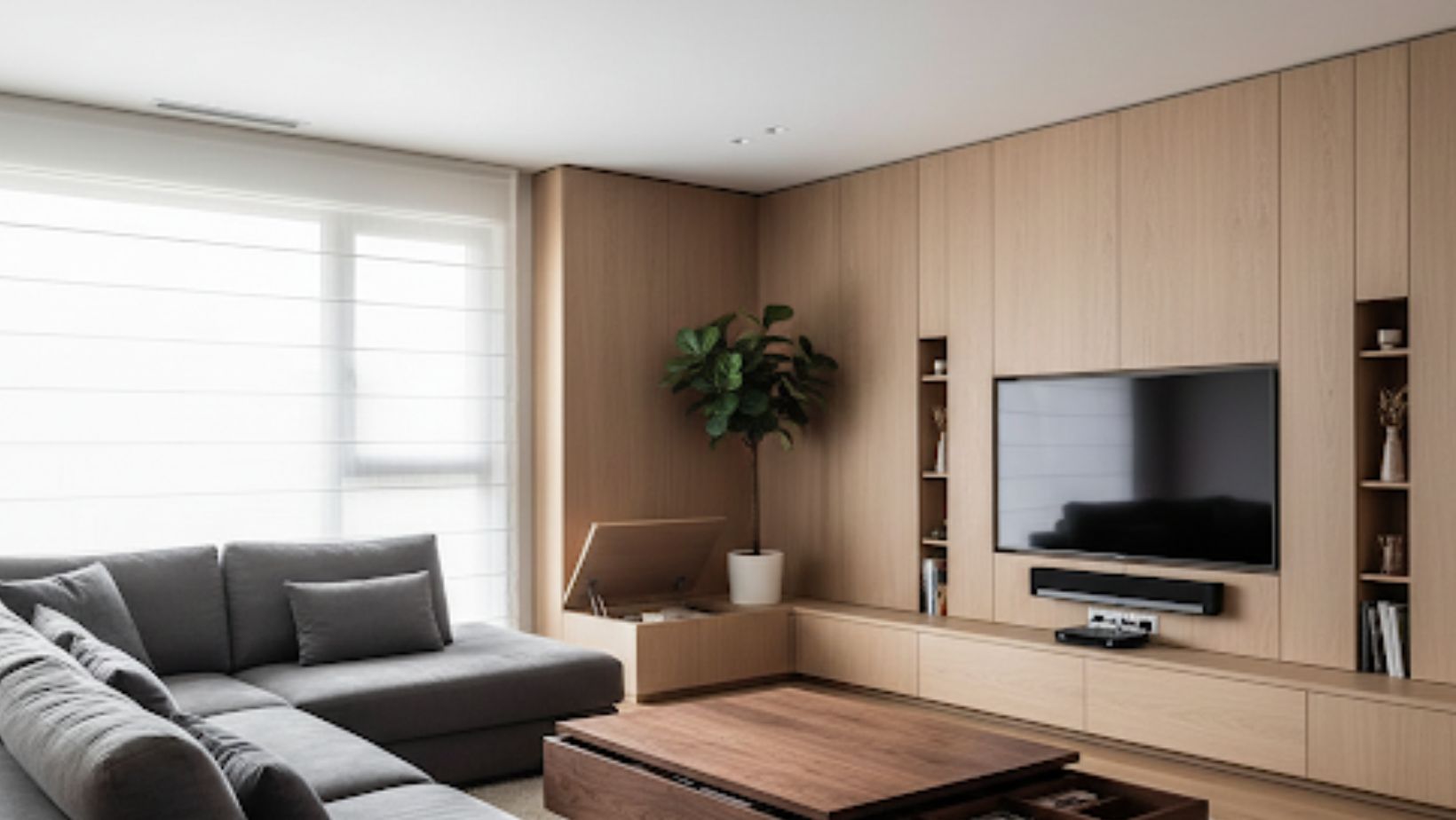
If you have a collection you want to display, that’s fine, but open shelving must be handled with extreme care. Hidden storage is required for everything else.
Reduce Open Displays: Although floating shelves are a great way to get rid of floor furniture (Hack IV), the overall effect is heavy if you fill them to overflowing with trinkets. Your books, DVDs, charging cables, and spare blankets should all be placed behind cabinet doors or inside opaque containers. The eye rests when the surfaces are clear, and the space feels instantly more spacious and serene.
Curation Over Collection: Select three or four sizable, striking, and exquisite pieces rather than fifty tiny ones. More room, fewer things.
Beyond built-ins, off-site storage can be your secret weapon for a clutter-free living room. Rotate bulky items like extra chairs, seasonal décor, or spare media equipment into convenient storage units on Firestone Blvd to free up floor space while keeping everything accessible in South Los Angeles. Label bins and keep a simple inventory on your phone so swaps take minutes—the lighter your daily load, the bigger your mirrors, lighting layers, and vertical lines will read.
Presenting The 70% Visual Rest Rule
This is the key to creating a tiny area that is both aesthetically pleasing and actually breathable.
The rule is to only fill a storage or display space, such as a credenza, console table, or bookshelf, 70% of the way. The remaining 30% of the area should be purposefully left empty.
It works because those empty gaps let the room ‘breathe’ and now the eye needs breaks to feel calm. The eye perceives a wall of items when a shelf is packed from edge to edge. The eye is allowed to rest when you take deliberate breaks. The overall sense of chaos is lessened by this visual breathing room, which also gives the space a sense of organization, purpose, and space. Empty surfaces, whether on a coffee table or a high shelf, are essential components of your small space design.
Silence The Appliances That Shrink Your Room
You worked hard to organize your shelves and leave enough space to create a calm, open feel in the room that makes it look bigger, and it sure worked!
But in this type of space, it is easy to overlook the refrigerator! Maybe you haven’t noticed that it is humming loudly and causing low level irritation, but when you do, it is a relief in this kitchen. Sometimes the refrigerator leaks, creating an additional mess of items needed to clean the floor. Discreet odors may seem fine, but a quick change in temperature in the space you’re sitting in leaves you with a nagging feeling that something is off; it’s also possible that it is preventing you from enjoying the space.
The solution is simple. Just have a repair specialist check out the refrigerator. Drips, weird smells, and noises can all be fixed with a refrigerator repair. After the fridge is fixed, the space feels like there’s way more room. It’s like decluttering, but for your senses. You get rid of the annoying distractions, and the room feels instantly larger. It is super peaceful, so it’s definitely something to keep in mind for the next time the fridge goes off.
Conclusion
You’ve just learned seven effective, specialized tricks that designers use to make any space seem more expansive. You now understand that color palettes, vertical space, light, reflection, and hidden storage are not merely pointers; they are basic changes in viewpoint. The following adjustments will turn your small apartment into a work of spatial illusion: mastering mirrors, embracing light colors, demanding multipurpose furniture, freeing the floor from the TV, using transparent pieces, layering light, and firmly following the 70% Rule.
About Author