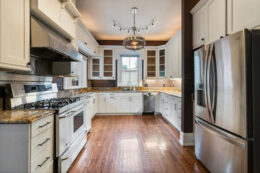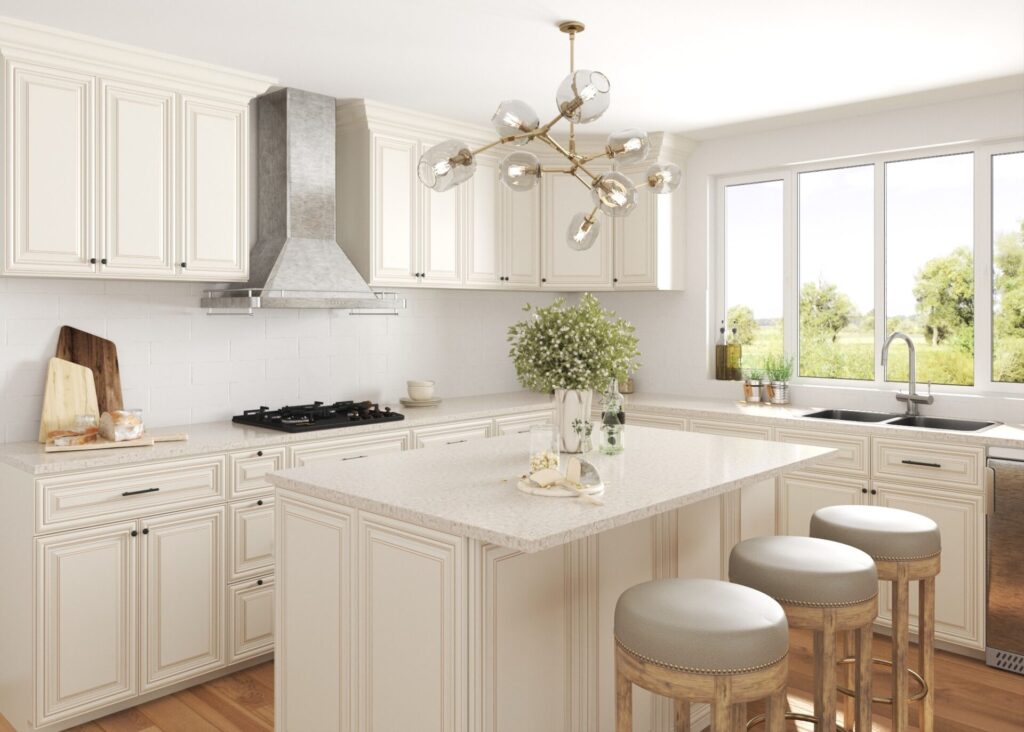
The cabinet door is the one kitchen decision that changes everything around it, so it is worth seeing exactly what it does. Picture a single kitchen: galley layout, north light, a run of base and wall cabinets along one long wall, white walls, pale oak floor, a window over the sink. Everything is fixed except the doors. Put a shaker door on that run and you get one kitchen; put a flat-panel slab door on the exact same boxes and you get a different one. Same footprint, same light, same everything else, and yet the room reads as two distinct spaces. The short version: shaker doors flex across traditional and modern and stay safe for resale, while slab doors commit hard to a contemporary look.
That is the whole argument for taking the door seriously. It covers more surface than any other element, and unlike paint or hardware it is the hard thing to change later. So before settling it, it is worth actually living in both versions for a minute.
The Shaker Cabinet Door: Soft, Warm, and Versatile
Hang the shaker and the room softens. A shaker door is a five-piece design, four frame pieces around a recessed flat center panel, and that recess throws a thin shadow line around the perimeter of every door. You read that shadow before you consciously notice it. It gives the surface a quiet dimension, a sense that the door was made rather than cut.
In our galley, that shadow line repeats down the run and gives the wall rhythm. The room feels considered, a little traditional, warm. Now mentally repaint those same shaker doors: in soft white they go classic and bright; in a deep green or navy they turn confident and current; in natural oak they lean Scandinavian. The door did not change, only the finish did, and the room followed each time. That is the shaker’s defining trick, the profile holds its character while the finish moves it across decades and styles.
This is also why the shaker survives trends. There is nothing in the profile tied to a single moment, which is why it sits comfortably in a farmhouse, a transitional space, or a minimalist flat, and why it remains the most widely chosen door across every price tier.
The Flat-Panel (Slab) Cabinet Door: Sleek and Modern
Now strip the frame away. A flat-panel slab door is one uninterrupted surface, no frame, no recess, no shadow line. Hang it on the same boxes in our galley and the room sharpens. The eye stops catching on those repeated frames and instead runs clean along the wall. The kitchen reads as architectural, deliberate, modern.
Because there is no profile to look at, the slab pushes all the attention onto the material itself. A high-gloss slab makes the room crisp and reflective, bouncing that north light around. A matte wood-grain slab makes it warm and minimal, Scandinavian in a colder, cleaner way than the oak shaker managed. The flat surface has a practical side too: no frame edges or recessed panel means fewer crevices for grease and dust, so it wipes down faster.
The cost of all that is commitment. Where the shaker drifted easily between traditional and modern, the slab plants a flag firmly in contemporary. Put a slab kitchen in a 1920s house and it reads as a choice, sometimes a beautiful one, sometimes a fight with the building.
Shaker vs. Slab: How the Two Cabinet Doors Compare
Lay the two versions of our kitchen side by side and the real decision comes into focus on a few axes.
On the range, it is not close. The shaker bends across styles; the slab is committed to one. If you are unsure where your taste will land in ten years, or you might sell, the shaker is the lower-risk door, simply because it pleases the widest crowd. On cleaning, the slab wins by a hair, its unbroken face has nowhere for grime to gather, though a shaker’s edges are hardly a burden with routine wiping. On finish, they reward opposite things: the shaker’s frame-and-panel gives a painted color depth and shape, while the slab turns a gloss or a grain into the entire event.
Worth noticing: the line between the two has blurred. The slim-frame shaker is one of several cabinet door styles that sit between traditional and modern, its narrower rail reading almost as crisply as a slab while keeping a whisper of that shadow line. In our galley it would land much closer to the modern version than the classic one, which is a useful escape hatch for anyone torn between the two.
Which Cabinet Door Style Should You Choose?
Back to the one real decision. Choose the shaker if you want a kitchen that ages slowly, flexes with your taste, and reassures a future buyer, the safe, generous, adaptable choice. Choose the slab if you are sure you want contemporary and you want the room to say so cleanly, the focused, confident choice. Neither is the right answer in the abstract. The right answer is whichever one matches the kitchen you actually want to stand in, and how much you are willing to commit to that vision now.
Frequently asked questions about cabinet doors
What exactly makes a door “shaker”? Five pieces: four frame rails around a recessed flat center panel. The recess creates the shadow line that gives the door its quiet dimension and its traditional-to-modern flexibility.
Will a shaker kitchen look dated soon? History says no. The profile has stayed in continuous demand for over a century precisely because nothing about it is tied to one era. Finish and hardware carry the trend; the door stays neutral.
Is a slab kitchen harder to keep clean? Slightly easier, actually, the unbroken surface has no frame edges or recess to trap grease and dust. The shakers are minor and routine wiping handles them.
Can I get a modern look without going full slab? Yes. A slim-frame shaker reads nearly as clean as a slab while keeping a hint of the frame, a common middle path for people who want modern but not stark.
Which door is safer if I might sell? The shaker. Its familiarity appeals to the broadest pool of buyers, while a slab kitchen appeals strongly to modern-leaning buyers and less to the rest.
Run the experiment yourself before you commit: hold the same room in your head, swap the door, and see which version you would rather cook in. The boxes are identical. Everything you are deciding lives in that one surface.
About Author