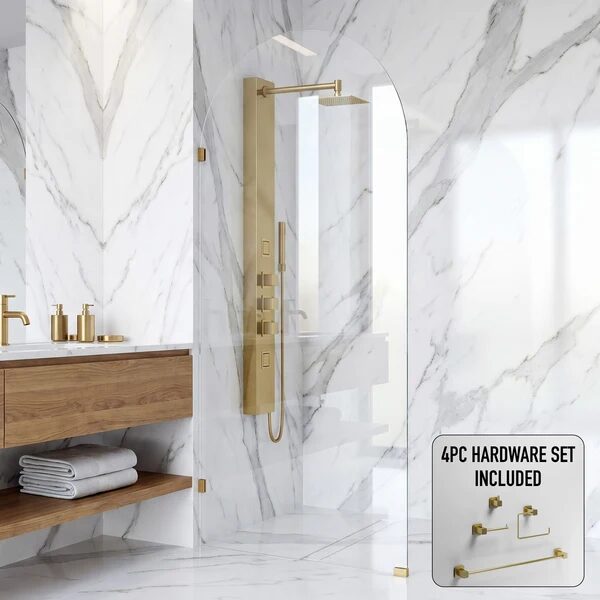
A shower door rarely exists on its own in a finished bathroom. It sits next to a drain, sometimes a screen or divider panel, and almost always some kind of hardware — a handle, a towel bar, a track. The problem is that most people still shop for these pieces one at a time, from whatever source happens to have the best price on each individual item. The result, more often than not, is a bathroom where the door hardware is “matte black” and the drain cover is a slightly different matte black, and the mismatch is invisible in the store but impossible to unsee once it’s installed under bathroom lighting.
Quick answer: A shower door set pairs a glass door with a matching drain, screen, or hardware accessory finished by the same manufacturer, which eliminates the finish-matching risk that comes from sourcing each piece separately. Buying components individually often means combining slightly different tones of the same named finish, since plating and coating processes vary between manufacturers even when the color name is identical.
The Finish-Matching Problem Nobody Warns You About
Finish names are not standardized across the bathroom hardware industry. “Matte black” from one manufacturer can lean slightly warmer or cooler than “matte black” from another, and the same is true of brushed gold, brushed nickel, and chrome. These differences are usually too subtle to catch from product photos on two different websites, but they become obvious the moment the pieces are installed a few feet apart under the same bathroom lighting.
This is the exact problem a shower door set is designed to remove. When a door, drain, and any included hardware come from a single collection, they’re finished through the same process, which means the specification risk is designed out before installation rather than discovered after.
What’s Actually Included in a Matched Set
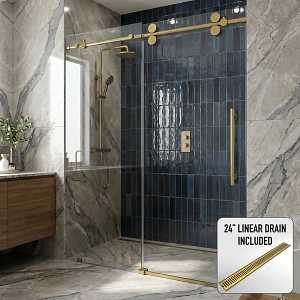
A typical shower door set pairs a frameless glass door — sliding, pivot, or hinged depending on the layout — with a matching linear drain and, in some collections, a coordinated hardware package. VIGO’s shower door sets illustrate this well: each set ships with the door and drain finished identically, in options like matte black, matte brushed gold, chrome, and stainless steel, along with all the mounting hardware needed for installation.
For bathrooms with an open or curbless layout rather than a fully enclosed shower, a fixed panel often replaces the door. VIGO’s shower screen sets apply the same matched-finish approach to that configuration — a stationary glass screen paired with a coordinated drain, which is increasingly common in walk-in and wet-room-style bathroom designs where a swinging or sliding door isn’t part of the layout at all.
Why This Matters Beyond Aesthetics
The visual argument is the most obvious one, but there’s a practical side too. Buying a door and drain as separate products usually means two purchases, two delivery windows, and two separate manufacturer warranties to track if something needs replacing later. A matched set collapses that into a single purchase and a single point of contact, which matters more than it seems to until something actually goes wrong with one of the components.
There’s also a design-integrity argument that’s easy to underestimate. Hardware finish functions as a visual through-line in a bathroom that’s otherwise dominated by tile and stone. When the door track, handle, and drain cover are visibly consistent, the room reads as intentionally designed. When they’re not, even a well-tiled bathroom can look like it was assembled from unrelated parts rather than planned as a whole.
Frequently Asked Questions
Is a shower door set more expensive than buying the pieces separately?
Not necessarily. Matched sets are often priced comparably to buying a door and drain individually, since the manufacturer is already producing both components together rather than passing on the cost of two separate supply chains.
Do all shower door sets include hardware?
Most matched sets include the mounting hardware needed for the door and drain, though the exact contents vary by collection — some also bundle towel bars or handles finished to match.
What’s the difference between a shower door set and a shower screen set?
A shower door set includes a moving door — sliding, hinged, or pivoting — as the entry point into the shower. A shower screen set uses a stationary glass panel instead, which is typically used in curbless or walk-in layouts that don’t require a swinging or sliding entry point.
The Takeaway
Buying a shower door on its own might save a small amount up front, but it shifts the finish-matching problem onto whoever is sourcing the drain and hardware separately — and that’s a problem that’s far easier to avoid at the purchase stage than to fix after installation. A matched set removes the guesswork, keeps the room’s hardware visually consistent, and simplifies the buying process down to a single decision instead of three or four separate ones.
About Author