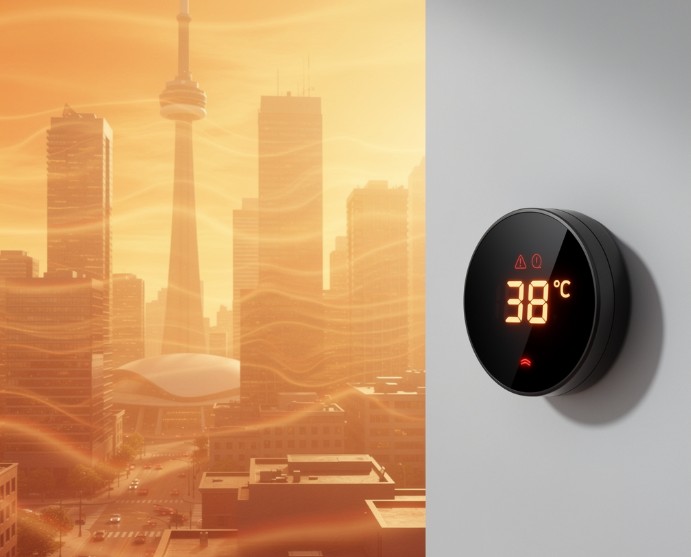
Toronto summers have evolved from pleasant lakeside breezes into humid endurance tests that leave us clinging to our vents like castaways clinging to a raft. It is no surprise that recent data indicates a sharp spike in utility bills across the Greater Toronto Area. The culprits are not just rising hydro rates but the silent efficiency killers lurking in our backyards and utility closets. When homeowners ignore early warning signs, they often face a desperate need for emergency AC repair services right in the middle of a July heatwave. It is a chaotic scramble that drains wallets faster than the humidity drains our energy. Instead of treating your cooling system like a set-it-and-forget-it appliance, viewing it as a high-performance vehicle prevents the sudden breakdown that necessitates costly residential AC repair and maintenance.
The “Ostrich Effect” in Home Maintenance
We are all guilty of it. We hear a strange clank in the basement or notice the air isn’t quite as crisp as it used to be, and we choose to ignore it. We bury our heads in the sand and hope the noise goes away. In the world of mechanics, noises never fix themselves; they only get more expensive. Ignoring these symptoms is like driving a car with the check engine light on while towing a trailer uphill. Eventually, the engine gives up.
This behavior is what drives that 18% cost increase. It isn’t just the price of electricity; it is the price of inefficiency. A system struggling to breathe through a clogged filter or working with low refrigerant has to run twice as long to cool the room. Experts who specialize in budget home maintenance and smart HVAC strategies emphasize that proactive care is the only way to keep those operational costs from spiraling out of control. You are paying for the machine’s struggle, not your own comfort.
The Anatomy of a High Bill
Let’s break down where the money actually goes. A standard air conditioner works on heat exchange. It pulls heat out of your house and dumps it outside. If the coils on the outside unit are covered in cottonwood fluff, dirt, or dryer lint, the unit cannot release that heat. It is comparable to trying to run a marathon while breathing through a straw.
The compressor has to work harder, drawing more amps and spinning the meter on the side of your house faster and faster. This is where the specific, actionable advice comes in: go outside and look at your unit. If it looks like it is wearing a sweater made of dust, it needs a chemical clean. This simple act can drop efficiency losses significantly.
Beyond the Filter: The Calibration Factor
Most people know to change a filter, yet few consider the calibration of the thermostat or the balance of the ductwork. If your thermostat is in a hallway that gets direct afternoon sun, it thinks your house is an oven and runs the AC non-stop, freezing out the rest of the family in the living room.
Furthermore, modern homes in the GTA are often designed with large glass windows that act as magnifying glasses. High-end design publications like Architectural Digest often discuss sustainable architectural cooling solutions that integrate passive cooling techniques. However, even the best architecture cannot compensate for a mechanical system that is out of sync.
Determining When to Call for Help
There is a fine line between stubbornness and prudence. You should bring in a technician when you notice inconsistent temperatures between rooms or if the unit is short-cycling (turning on and off rapidly). These are the cries for help your system makes before it dies completely.
The goal is to stop throwing money into the void of inefficiency. By acknowledging that your cooling system is a complex machine requiring respect and care, you can reverse that 18% premium. Treat your home’s climate control with the same attention you give your vehicle, and you will find your summer bills shrinking back down to a comfortable size.
About Author